UAV & FPV Technology
Practical experience informs what we develop.
A development project often starts with a limitation encountered in use: equipment that is difficult to integrate, a housing that does not suit its environment, or a component that needs to be redesigned around the user.
WEPA’s Robotics & AI team develops FPV platforms and supporting equipment, bringing hands-on piloting and assembly experience into the design process.
Our work includes custom aircraft, protective housings, battery enclosures, and complementary equipment for FPV pilots.
We work with your technical team to turn a requirement into a defined development project, with specifications, prototype reviews, and evaluation criteria agreed from the outset.
The aim is to develop equipment that addresses a clear need and can be manufactured, maintained, and supported beyond the first prototype.
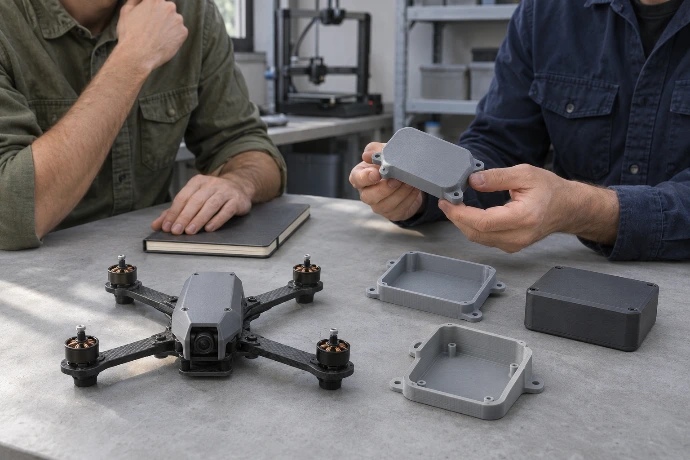
Where Development Begins
A Requirement Existing Products Do Not Meet
Available equipment may address part of your requirement while leaving a specific constraint unresolved.
We review that gap with your team to determine whether it calls for an adaptation, a dedicated component, or a new design.
The starting point is a clearly defined problem and the improvement you need to achieve.
Feedback From Practical Use
Repeated handling can reveal limitations that were not obvious during the initial selection: awkward access, exposed components, or parts that are difficult to replace.
Our Robotics & AI team uses feedback from pilots and technical personnel to identify what needs attention and establish priorities for prototype evaluation.
A Prototype That Needs to Be Reproducible
A successful prototype is a starting point for production, with further work needed to make subsequent units consistent.
We review material choices, component availability, assembly requirements, and documentation.
These considerations help establish what must be resolved before committing to a production run.
From Requirements to a Reviewed Design
Each development stage should answer a defined question.
We agree on what needs to be demonstrated, record the findings, and review the next step with your team.
Define the Design Requirements
We translate the initial request into a documented scope, including intended use, physical constraints, interfaces, and maintenance expectations.
We also identify assumptions that need to be checked.
This gives everyone a shared reference for assessing design proposals and managing later changes.
Evaluate & Refine the Prototype
A prototype gives your team something concrete to examine against the agreed requirements.
We document observations, distinguish necessary changes from optional improvements, and agree on the revisions to pursue.
Updated versions are reviewed against the same criteria so progress can be assessed consistently.
Prepare the Manufacturing Handoff
Before a design moves toward production, we establish the approved version and the information needed to reproduce it.
Depending on the project, this may include drawings, material specifications, a component list, assembly documentation, and inspection criteria.
Responsibilities for manufacturing and acceptance are agreed before the next stage begins.
You do not need a finished specification.
Start with the problem you want to address, who encounters it, and the limitations of the current solution.
Photos, sketches, or user feedback can help explain the need.
We then identify the information required to assess the project and define an initial scope.
Yes. We can review an existing design or prototype and discuss the work you want us to undertake.
We first clarify the documentation available, previous evaluation results, and any restrictions on modifying or sharing the design. The proposal then identifies the development tasks and responsibilities assigned to WEPA.
Before sensitive information is exchanged, we agree on appropriate confidentiality arrangements.
Ownership of existing designs, newly developed work, and project documentation is addressed in the project agreement.
We also clarify what information may be shared with manufacturing partners and for which purposes.
Discussing Your Development Project
You may have an initial concept, feedback from existing equipment, or a prototype that needs further work.
Our first discussion helps establish the project’s maturity and the contribution you need from WEPA.