Ballistic Protection Development
From a defined threat to protection built around the user.
A ballistic protection project starts with the threat to be addressed and the people or equipment to be protected. Coverage, weight, mobility, and the conditions of use shape the development requirements.
WEPA’s approach draws on founder Luc Schwab’s experience in ballistic protection production and process improvement at Universal Shield Holding SA, working with hard armor, soft armor, shields, and custom protective inserts.
That experience connects material performance with manufacturing constraints and the practical demands of the people who rely on the protection.
We develop custom ballistic protection solutions around specific client requirements, including threats outside the scope of commercial and industry standards.
Working with material specialists, manufacturing partners, and testing laboratories, we define the development scope, prototype evaluation, and evidence required to assess the proposed solution.
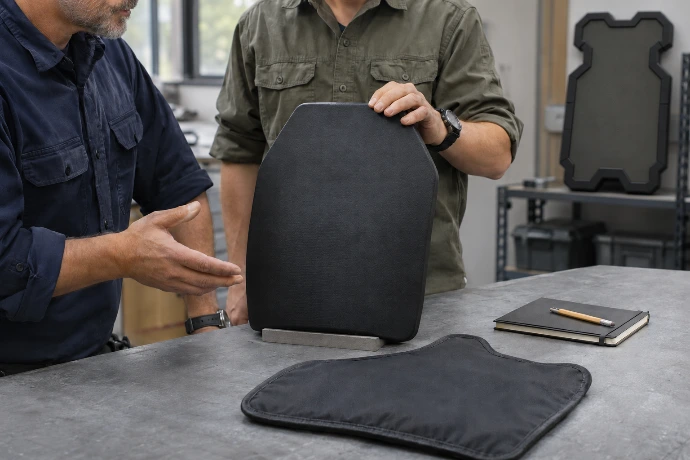
Experience That Shapes the Development
Understanding the User
Protection must be considered alongside the duties of the person carrying or wearing it.
Luc Schwab’s work with police and military customers, including client training during his collaboration with Universal Shield, informs how WEPA approaches coverage, handling, mobility, and integration with other equipment.
Working With Material Specialists
Material selection connects the protection requirement with the constraints of the finished product.
Luc’s experience includes integrating Kevlar® and Tensylon® materials into ballistic protection products during his work with DuPont. These brands are now part of Arclin’s portfolio.
That background informs discussions with material specialists about suitable options, supporting documentation, and the evaluation needed for a proposed application.
Bringing Production Into the Design
A design must also account for how it will be manufactured and checked consistently.
Luc’s responsibilities in ballistic protection production and process improvement at Universal Shield inform WEPA’s approach to manufacturing feasibility, quality controls, and the transition from prototype work to repeatable production.
What We Define Before Development Begins
A protection requirement needs to be specific enough to guide design decisions and evaluation.
We work with your team to establish what must be demonstrated and the constraints the solution must respect.
Threat & Evaluation Scope
We clarify the threats to be addressed, the intended application, and the standards relevant to the request.
Where a requirement falls outside established standards, we work with qualified testing laboratories to define an appropriate evaluation scope.
Results must be understood in the context of the conditions tested.
Coverage & Practical Use
Protection needs to account for the way a product is worn, carried, or integrated into a larger system.
We review coverage, dimensions, weight, handling, and compatibility with other equipment.
Your team’s feedback helps identify the practical constraints prototypes must address.
Manufacturing & Acceptance
We establish the documentation, inspection requirements, and approval stages needed to move from development toward production.
The proposed scope distinguishes prototype evaluation from production acceptance.
Changes to the approved design are reviewed for their potential effect on performance, manufacturing, and the evidence supporting the product.
Describe who or what needs protection, the intended use, and the limitations of your current solution. Include any required standards, approximate quantities, delivery location, and target date.
If you have a specification or previous test documentation, let us know. We can agree on confidentiality arrangements before exchanging sensitive information.
Yes. We can review the available design information, previous evaluation results, and the changes you want to explore.
We first clarify ownership, access to documentation, and permission to involve relevant specialists.
Any proposal then identifies the work WEPA will undertake and the responsibilities your team will retain.
No. A test report records results for the samples and conditions evaluated.
Certification, where applicable, follows the requirements of the relevant certification program.
We distinguish development testing, customer acceptance, and certification when defining the project.
Claims about the finished product must remain consistent with the supporting evidence and any certification actually obtained.
Discussing Your Protection Project
You may have a formal specification or a need that existing products do not address.
Our first discussion helps establish the information available and the work needed to assess your request.