Personal Protective Equipment
Protection starts with understanding the exposure.
The equipment your personnel wear needs to address the hazards they face while allowing them to carry out their duties.
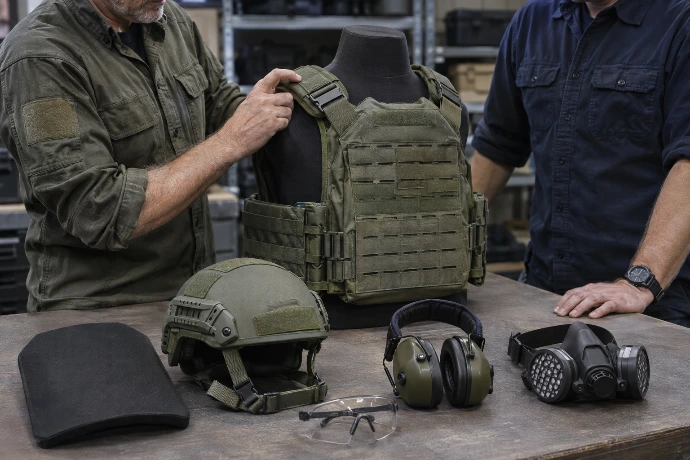
WEPA helps you define those requirements and select personal protective equipment, from ballistic vests, plates, and helmets to eye, hearing, and respiratory protection.
We consider the required protection, fit, and compatibility with the equipment your team already uses. How long it will be worn, the conditions of use, and the tasks involved all inform the selection.
Alongside equipment from our selected manufacturers, we develop and manufacture custom ballistic protection solutions for specific client requirements, including threats outside the scope of commercial and industry standards.
For these projects, we work with you to define the threat, operating constraints, and criteria for evaluating the proposed solution.
Protection for Your Personnel and Their Responsibilities
Equipping a Team
Your personnel may carry out different duties within the same unit.
Their exposure, equipment, and time spent wearing protection can vary.
We help you define what should be common across the team and where individual roles call for a different configuration.
Reviewing Existing Equipment
A change in duties or operating conditions can raise questions about the protection already in service.
We review your requirements with you, including fit, compatibility, and the information available on the equipment’s condition and service life, to help identify what needs attention.
Addressing a Specific Threat
Your requirement may involve a threat or a combination of constraints that an existing product does not address.
We work with you to establish a clear specification for a custom solution, including the protection sought, coverage, weight, and conditions of use.
What We Help You Define
Choosing protection involves more than selecting a product or a rating.
We help you examine what the equipment needs to protect against, how it will be worn, and what evidence supports the choice.
Threats & Protection Requirements
We work with you to describe the exposure and establish the protection required for each role.
For ballistic protection, we examine the threats covered by the available test documentation and whether the conditions represented are relevant to your requirement.
A protection rating needs to be understood within its stated scope.
Fit & Equipment Compatibility
Protection needs to fit the wearer and work with the rest of their equipment.
We consider coverage, adjustment, and freedom of movement, along with the interfaces between items.
A helmet, eyewear, hearing protection, and a respirator may each fit individually yet require careful selection to work together.
Evidence & Acceptance Criteria
We review the available technical documentation, sizing information, care instructions, and service-life guidance with your team.
For a custom solution, we agree on the performance to be demonstrated and the evaluation required.
Where a threat falls outside existing standards, we define specific acceptance criteria with you.
Start with the intended use, the personnel concerned, the quantities, and your delivery location and timeframe.
If you have an equipment specification, a required protection standard, or a list of items already in use, include those details. We can agree with you on how to share sensitive requirements before discussing them further.
Yes. We review your specification with your procurement and operational contacts, clarify any points that could affect the selection, and identify suitable options.
If we propose an alternative, we explain how it differs from the original requirement so your team can assess it before making a decision.
Start by describing the requirement that available products do not meet.
This may concern a particular threat, coverage, dimensions, weight, or integration with other equipment.
We then establish the scope with you, including feasibility, development stages, evaluation, and the information needed to prepare a proposal.
Any proposed timeline accounts for those stages.
Planning Your Equipment Requirements
Whether you have a detailed specification or are still defining the need, our first conversation helps establish what information is available and what needs further clarification.